
Hidden truth, hiding information and spiritual interviews

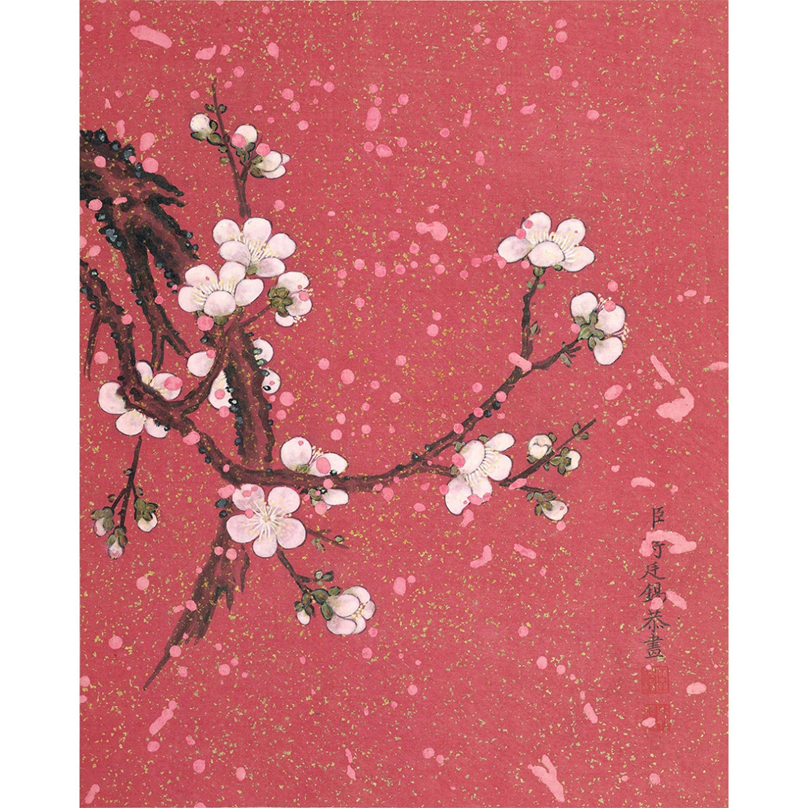
(Paintings and Poetry Devoted to the Countless Fragrant Flowers, Plum Blossoms, Jiang Tingxi, Qing Dynasty. Source: National Palace Museum in Taiwan*/**)

All art books were safely delivered into the hands of anonymous artists and staff members at the Moodii platform company, just as I had promised them. Moodii’s CEO and his secretary have written to me saying that they really appreciate how my research provides them with some unique insights into mental health issues, being able to use art to show the life and spirituality of those mentally vulnerable or ill. I was quite pleased to hear this, although the art book was not really meant to reflect ‘all my life struggles’ as many seems to assume this is the case. And I did the same, as if I could ‘see’ Marco’s ‘trouble’ in his (re)-editing of the book.  

It is not always the case that what researchers write about is a complete reflection of who they are, nor do they project their subconscious or unconscious consents, such as repressed desires, sufferings or pains, into their writing. I have been quite careful about not putting my ideas into the heads of interviewees/artists. But does one’s subconscious content find its way into the curation of the artwork and the subsequent book? Yes, it is a possibility. But does this change the reality that researchers intend to find out? To what extent the reality is just a reflection of researcher’s mind, such as fear, anxiety, insecurity and perhaps intellectual idea? Would the ‘truth’ be differently constructed if these (subconscious) projections are removed?

Then I start to reflect on my roles in the art curation and interviewing participants. I think I see curation as a way of pulling out a thread from what might be thought of as different worlds, genres, and psyches – where things are perpetually forked and fragmented. It is to create a meeting place that holds different pieces together for a direction that sheds light on certain truths buried deep under projections, mirrors, and defence mechanisms. Where does a researcher such as myself stand in all this? I am content with what Edith Stein (2002, p.37) wrote: ‘go out of oneself’ because this going-out leads ‘I’ away from its ‘ego’ into the world. The spiritual ‘truth’ uncovered there is otherwise not possible to see in the individual projections, desires and ideas. Art curation, then, makes it possible to bring in something originally larger by threading differences that let each version of the ‘truth’ shine alongside each other, without setting them in competition. This threading, indeed, is my interpretation of ‘research materials’, and that would have been quite different for a different researcher. In threading, I have found my answers from this research project, which might have been different for participants. These answers are really not all about ‘me’ yet do hold a partial representation of my faith, judgement, and spirituality as a researcher and as a human being.

Similar roles are taken for interviewing vulnerable participants. Edith’s going outside of oneself makes me think, again, of Bourdieu’s (1999, p. 612-615) piece on interviewing as a spiritual exercise. For Bourdieu, the spiritual self is put in his words: ‘forgetfulness of self’. However, he has not explained in detail as to how this ‘welcoming position’ in spiritual interviews (citing Marcus Aurelius, which is probably the Western equivalent of Daoist spirituality) actually works to ‘make the respondent’s problems one’s own’ and ‘understand them just as they are in their distinctive necessity’ (1999, p. 614). This sounds almost like empathy yet without distancing oneself from the researched. And without really saying where does the researcher empathise with the interviewee? It reads like from the interviewee’s emotional world; yet this creates more problems as Bourdieu writes in the later paragraph saying that the interviewee can manipulate this empathy and use this chance to ‘stage’ their statements to the public. In a slightly different way, Edith Stein also couldn’t really solve the ‘verification’ problem in her concept of empathy when the interviewee intends to lie about their feelings alongside other contextual information.

Well, I want to forget about these two concepts for a minute because they are both not helpful in solving practical problems during interviews: hiding information (either intentionally or unintentionally). In recalling years of experience of doing interviews in various places and languages, I think I can tell when an interviewee is lying or, to put this in a nice way, hiding critical information from me. The recent and obvious one is this interviewee who has really answered all the interview questions in a way that is way too perfect. No stutter. Not much pausing. Everything he said sounds like reading out from a well-prepared script. And the critical point comes when he deliberately avoids all the sub-questions on spiritual wellbeing and kindred spirits and so on. As usual, I pretended that I did not know he lied to me about his perfectly crafted experiences and still went through most questions yet rather mechanically. I felt like by the end of the interview both of us knew that this was just a script and we had to just go through and really ‘perform our duties’. I still gave him the research compensation for the interview. And then he lied again to me that he wanted to participate in the art workshop yet disappeared. Well, there you go.

Usually when interviewing officials and policymakers, I would present certain information and use that as a source for cross-examination, but I think that was because I already assumed they might hide information from me and their conduct would damage the validity of my research. So interviews with elites are more like an interrogation; yet with the general public or vulnerable participants,  interviews become more like a spiritual practice in a Daoist way where there is still a boundary between the researcher and the researched yet both of you know that you are connected in a way that is not expressible (cf. Bourdieu’s ‘expressed intensity’) but possible to be verified in spoken words afterwards. This is the two positions that I occupy when doing a spiritual interview.

I remember my first Finnish master’s student told me, soon after coming back from a suburban community, that “you made everyone feel very special about themselves“. I started at her description and not sure what to say because I had never thought that way. On reflection, perhaps that is when I realised what it is for an interview to be done in a spiritual way. Each interviewee should feel no fear to express their opinions freely and know that their uniqueness will be understood unconditionally, therefore there is no need to ‘perform’ or ‘charm’ researchers by exaggerating, twisting, or inflating whatever it is they want to say. Unconditional understanding does not allow researchers to commit the crime of ‘symbolic violence’ to the researched. In exchange, researchers get something as truthful as from the soul/heart of participants. Whether these are immediately conceptualisable is another question.

In the spiritual space, it is very easy to know who is hiding the information…but of course, as a well-trained and experienced interviewer, I also know how to sit through and smile and provide that ‘felicitous condition’ without too much effort (Bourdieu, 1990, p. 614), despite deep down there, I know someone is hiding information. However, I am unsure if this felicitous condition is really spiritual at all. Nothing like what Edith describes spirituality as ‘feelings with depths’. But, I’d like to think about spirituality, in a Daoist way, as setting one free from one’s ego and letting go of whatever it is that causes pain and suffering to your ego (rather than ‘completely forgetting about yourself’). This way, I can, again, hold upon two positions that allow me to see through the hidden meanings without personally getting involved and without saying a single word. In contrast to Bourdieu’s ‘taking their problems one’s own’, I take their problems ‘as if’ they are mine but I, all the way through, know they are not my problems. But this boundary does not prevent me from resonating with participants from the heart of the Universe.

Reference:

Bourdieu, P. (1999). Understanding. In P. Bourdieu et al. (Eds.), The weight of the world: Social suffering in contemporary society (pp. 607-626). Polity Press.

Stein, E. (2002). Essential Writings. Orbis Books.

*It is a well-known fact that the KMT ‘brought’ gold and treasures to Taiwan during WW2. The National Palace Museum owns the largest and most valuable Chinese artworks, playthings, china, calligraphies (treasures really) from the royal families.

**This visit to Taipei, I finally found time to take J to the museum and spent some of my salary on purchasing two replicas: one printed on rice paper / another framed in a traditional way. Not that I am ever a big fan of Chinese paintings, but they are something to remember Taiwan by.
Posted by yushan

An art book about my exhibition of Taiwanese outsider art


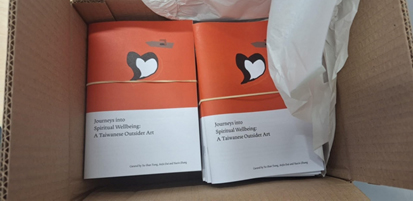
After months of anticipation and work, I find myself less excited than expected when seeing the outsider art exhibition now encapsulated in an art book. This little art book is certainly not as serious as typical academic publications. Yet it carries aesthetic and creative expressions of deep feelings that are difficult to be put into words. A great deal of care and thoughts have gone into the design of this book. Talks from the launch event become paragraphs that introduce the exhibition to readers. Words from authors become the ‘voice’ of the artwork. Photos of dialogues, drawings and ideas from the public become section dividers and the final message of the book.

With many thanks to Marco, who did a superb job in accommodating my strong idea about the format, the colour and front image of the book (as well as the final touch of the sticker with ISBN number in it…). Some people might feel a sense a familiarity of this book, which takes its size and front design from the Café Royal book series. Personally, I think that is just a perfect ideal for this ‘boutique’ art exhibition book. Something I have imagined for the book before it takes its shape.

It is hard to describe how I really feel when I pick up a box of book copies and open it up at the office. A sparkle of joy? A sense of lost? I feel rather at ease, probably because this is really towards the end of the fellowship, with outputs disseminated one by one from the pipeline, as they should be. I am very pleased with how the exhibition went and ended up as copies of book with its spirit and creativity kept ‘alive’ in another format yet distributable and somehow become ‘permanent’. Looking back, I think what the exhibition attempts to deliver is to elicit a sense of self-empowerment in people for the spiritual to be creatively and naturally expressed in artwork, in sound, in spoken or written words, without forces. Spirituality (and all the ideas and feelings below the conscious) reveals itself in different ways that, for some, becomes a source for healing, especially in a world fought with biases, fears and apathies. It is always there, dwelling in the heart that connects all things, people, worlds together with the Universe.

In going through the final design, I have thought a thousand times about how this exhibition really means, for research participants and many others struggle with their mental health. Perhaps not very much. But I remember one of the research participants told me that he, indeed, had found a moment of peace while drawing his heart that has been constantly ‘hollowed out’. I remember very clearly that was one of the interviews where the weak internet signal has made his voice cutting out at random. But I really tried to get to what he was saying. He said: I like to use contrasting colour because I cannot see very well, I have some visual disability. And I thought to myself: ah, so that is how his world looks like. So very bright and vivid, just like his spirit (soul).

For sure, I will be fully relieved when I send these copies to research participants in December because I have promised to share the exhibition information with them! I am not quite sure if I can still manage to re-contact all of them, after almost two years since the fieldwork in Taipei back in early 2024.

Spirituality finds home when love does not speak human languages.


Posted by yushan

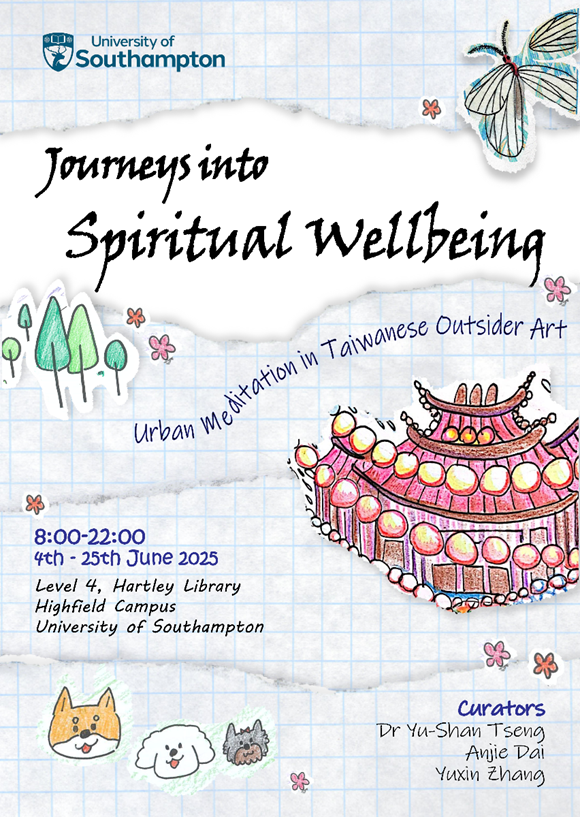
Introducing a Taiwanese outsider art exhibition at the University of Southampton: ‘Journeys into Spiritual Wellbeing’, 4th-25th June ’25

I am very pleased to announce that a Taiwanese outsider art exhibition is coming soon to Level 4 Gallery at Hartley Library, University of Southampton, from 4 to 25 June!

This exhibition showcases 18 drawings created by anonymous artists living with mental health conditions in Taiwan. Expressive, whimsical and deeply emotional, these artworks belong to the genre of Outsider Art—creative expressions that emerge outside formal institutions—in their celebration of raw, unpretentious personal experiences.

This outsider art collection embodies aesthetic expressions for urban meditation, a meditative experience known in Taiwan as “self-detachment” (放空). Unlike traditional meditation confined to secluded or sacred spaces, the self-detachment meditation channels moments of stillness into the rhythms of everyday urban life—walking in city streets, riding public transport, cycling through neighbourhoods.

Through outsider art, this exhibition translates meditative experiences into journeys for spiritual wellbeing. Each artwork has captured spiritual states of inner awareness, emotional clarity and transcendental connection. In our increasingly disconnected urban environments, this collection offers glimpses into how everyday meditation can initiate spiritual journeys towards self-healing where trauma and pain are given new meaning and transformed.

From 4th to 25th June, this exhibition will be on display at the Level 4 Gallery in Hartley Library, the University of Southampton. We invite you to embark on your own journey into spiritual wellbeing. Ponder these drawings. Bring your (Bluetooth) headphones to listen to the artists’ descriptions of their work and self-detached experiences. Discover what urban meditation might mean for your own soul and spirit. Come and practise your own urban meditation and share your experiences on the DIY wall!

You can also find posts and updates about th exhibition on Instagram: @Journeys_Spiritualwellbeing

Share what you think of the exhibition and/or your meditative and spiritual journeys through hashtags #spiritualwellbeing #outsiderart #soton #meditation #city @Journeys_Spiritualwellbeing Hope to see many of you at the launch (4th June, 11:00) and in the exhibition! xoxox

Posted by yushan

Everyday dialogues

Dialogue 1

L: I thought philosophy was about common sense. I was quite wrong about it then.

G: No, you’re not wrong. That’s what it’s supposed to be.

L: Then why is it all about ontological correction nowadays? All these grand theories, if not grand positivists.

G: Well, I don’t know, really. Most people don’t think. They don’t ponder these kinds of questions.

L: Why did you decide to become a geographer then? Is it just about the title, fame and money?

G: Well, I’m not good at any other jobs.

L: So am I. But you want to be famous.

G: Do I?

L: Yes, you do.

G: Shall we cross the bridge to the other side, then?

L: No, it’s too late. Too much water has flowed under the bridge.

Dialogue 2

T: There is no democracy in this country.

Y: Is there not?

T: No.

Y: But this isn’t China. There’s freedom of speech.

T: No, there isn’t.

Y: Are you sure? Surely, people don’t put up with self-censorship.

T: No, that’s exactly what I mean. You can never say what you really want to say in this country.

Y: Like what?

T: I can’t use the word ‘cripple.’ But I like to use it.

Y: Well, because it’s not PC to use that word to describe disabled people.

T: But I don’t mean to offend disabled people when using that word, you know. It’s just how I’d like to call them. I’d call myself a cripple if I were disabled.

Y: But what if disabled people feel disrespected when you call them ‘cripple’? Don’t you have to respect how they feel?

T: I don’t. Fuck them. Because no one ever cares how I feel.

Y: Oh, well, that’s democracy for you, then.

Dialogue 3

P: Why must I give a reason for everything that I do?

D: Because that is what normal people do. To justify your conduct.

P: What if you just invent a reason that, despite looking good on the surface, you know doesn’t make sense to you at all? Deep down.

D: Well, you’re deceiving yourself. You allow your own reasoning to break the ears of the vessel midway through transmutation.

P: Hmm…

D: I guess not everyone wants to eat the pheasant’s fat. And I am one of them.

P: At least you have not spilt it out. Give it time. Wait for the rainfall, then you will be able to see the ‘truth’ that appears strongly unfamiliar to your brain and desire. You will be able to feel it with all your heart.

Dialogue 4

Y: But he’s very mentally vulnerable, and it’s not fair to ask me to take care of him.

D: I don’t believe in mental health, you see…

Y: Do you not?

D: No, it’s not a real illness.

Y: I see… Oh, well… Why?

D: I think people just invent that illness for nothing.

Y: Hmm.

D: What’s your new research project about?

Y: Well, it’s actually about mental health…

Dialogue 5

L: Is it possible to defer any decision to a certain point in the future?

D: Well, that’s what makes Derrida different from Foucault, isn’t it?

L: Yes, I think so. What do you think, then?

D: I think it’s possible.

L: You do realise that’s a decision made at the point when difference overthrows historical repetitions, right?

D: Well, I never liked Foucault. His writing is too flat. Nor do I like Derrida. Everything about him is text.

L: I don’t think you’ve given Derrida enough justice. But that is not my point. I only care about whoever leads to a different opening, a different future. No one should burden themselves with the weight of others’ histories that one has never partaken in. It is unfair.

D: True, but what drives one’s decision? Have you thought about that?

L: No. But now since you ask, I think it is the will of heaven and earth.

D: Oh?

L: You can never defy their will.

D: Can you not?

L: No.

D: What if you do?

L: Then your decision is no longer authentic. No longer aligned with the working of universal spheres. Out of sync. Off.

D: What does that leave us then?

L: There is never ‘us’, only the Oneness. What binds together is exactly what splits it apart

Posted by yushan

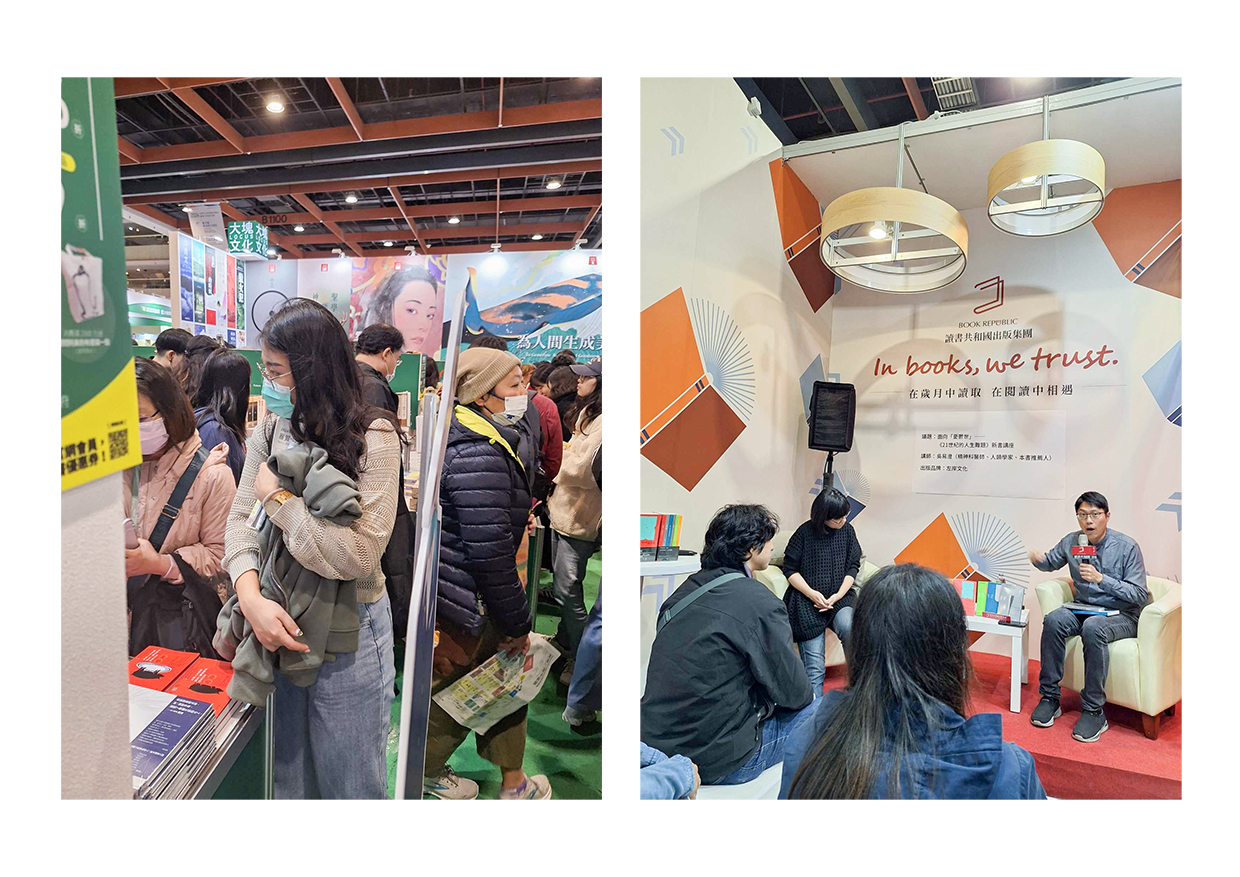
At the book fair: ambiguities of’mental health’ in Taiwan

It was a cloudy Sunday. I still felt overwhelmed with all the things going on in the field: getting in contact with new informants, arranging interviews with research participants, and catching up with family members and old friends. In the meantime, I have to maintain necessary correspondence with a few people in the UK, which is much more enjoyable than spending hours getting expenses claimed and reclaimed. And I must not forget to write that weekly check-in email to my line manager, in just one sentence, literally without saying anything at all. How lovely.

I sometimes forget which time zone I am living in—probably both. Having people in two places whom I love, feel for, and at times worry about stretches my body and mind in a strange way. However, having many lines of flight as sources of comfort and assurance from afar is certainly helpful when things get challenging, and sometimes, out of hand, here in Taipei. Or vice versa.
Well, that is all beside the point for today’s highlight: a book salon that introduced a translation of a series of books from Oxford University Press, ‘A Very Short Introductions,’ on selected issues—love, depression, anxiety, superstition, pain—into Traditional Chinese for Taiwanese readers at a major book fair in Taipei.
 
Everyone surely loves the name of Oxford, I thought to myself. In my view, the two books on depression and anxiety are highly informative for the general public – they got every discipline covered, from behavioural psychology to neurobiology – and even critically addressed the contested natures of depression and anxiety. I hope the latter does not get lost in the translation. Without doubt, they are good choices for the Taiwanese readers. Absolutely undebatable. But I prefer my recent read: ‘Mad world: the politics of mental health’, which grounds mental health in its very own complexity, diversity, and ambiguity.

But I quickly found myself amused when the speaker, a psychiatrist, at the book salon broke the opening by saying, ‘Oh, and today we are only going to focus on the two books “Depression” and “Anxiety,” despite others, like “Love”.’ Then, he quickly highlighted that ‘all authors of the two books have medical training,’ as if this immediately grants legitimacy to whatever knowledge these books claim about mental health issues. In Taiwan, any scientific knowledge gains an incontestable status of objectivity. Just like God’s view. And that was his way of setting the mood for the audience. It certainly feels very Taiwanese.

What I liked most about his talk was how he captured the layers of ambiguity surrounding mental health in Taiwan, particularly in terms of its terminologies, diagnoses, and solutions. 
 
On the one hand, he is certain about mental health being diagnosed and getting treated according to psychiatric categorisations and medications. That is what he was trained for.
That was the moment when he went on briefly talking about things happening in the medicalisation of mental health in Taipei. Experts (policy-makers, vendors and psychiatrists) came together to celebrate the new invention and spread-out of a medication – Prozac – since the 1990s by taking serious mental health issues in Taiwan.
 
(And because now we’ve got an elixir. Problems solved. I thought to myself.)

On the other hand, he is uncertain whether his prescription or ‘professional’ judgement is the best way to solve mental health issues such as depression and anxiety for such issues are social ones.
 
At some points, he turned to talk about how much he does not think an expert like himself as a psychiatrist knows exactly how to treat mental health. There is not a ‘correct’ answer to all things mental health. Mental health should not be thought of as an issue for experts like him. Prozac, rest, counselling, resignation of work or removal from ‘stressed’ relationships or environments. Some works on some but not others. 
 
Even naming the diagnosis itself is highly contested. While few highly educated (young) patients accept and prefer to be diagnosed with the ‘western’ terminologies such depression, anxiety and bipolar; many prefers the socially more acceptable ones: hormonal or autonomic imbalance, which sound both ‘professional’ enough (there are some problematic neuroses being identified and will be treated) and ‘neutral’ (for you are not actually ‘mad’ and won’t be socially stigmatised).

At this point, he was honest about himself feeling ‘helpless’ in the face of his patients, with all sorts of mental health conditions, with different expectations of him.
Some of his patients do not like to go to see him. They can hardly describe their ‘conditions’. They can hardly speak.

Some are wanting an affirmative and immediate solution from him because they don’t feel well. They are overwhelmed by strange bodily pains and physical weakness. They fear not knowing what to do with their conditions. They want to get well immediately.

“‘But how long do I have to wait before I get well, doctor?’
‘How can I get better? How can I alleviate all the pain in my body?’
‘Will I stay well forever once I feel better?’
‘Is this well enough?’

At this point, I couldn’t help but think how terrifying it must be for an expert to be questioned by 30-50 random individuals each day, all trying to meet their ‘unsolvable’ expectations. At the same time, it was clear that he grounds mental health issues in ambiguity, navigating between his medical authority and personal despondency. It was as if the talk itself mirrored a labyrinth, reflecting his frustration over treating patients with mental health problems.
 
However, I thought such ambiguities also conveniently obscured the power relationship between experts as authorities and patients as powerless within Taiwanese society.

At the end of the talk, the editor talked about something more positive. She was certainly a very clever woman. She talked about how being diagnosed with the certainty under the medical terms could become the source for building a strong identity amongst those who have the same illnesses. Indeed, being certain about one’s illness can be very positive.

But what took me by surprise was when a middle-aged woman raised her hand and spoke about her experience of PTSD and depression with absolute confidence: “I had a few counselling experiences, but I didn’t like them. What I realised is that you can only depend on your strength. You must cut yourself from all the thoughts and environments that have oppressed you. I do not think it is a disease but we all have a tendency to be ‘lazy’….but what do you think is the best solution for mental health, Doctor?

I thought that was an interesting question and statement. Especially her use of the words ‘laziness’ and ‘the best solution’. I suppose what she meant by ‘laziness’ was not to immerse yourself within the negative thoughts and experiences of the past, present and future. Or simply to be possessed. Sometimes we cannot control what we feel and do especially at the moment of weakness. I thought of a passage in which Deleuze interprets Spinoza’s ethics: we do not know what our mind and body is capable of doing…

For that woman, judging from the look of her which is full of life and light, I believe, already found the answer to her ‘problems’. She already pointed out the ‘answer lies in oneself’ but however, in a society like Taiwan where doctors hold a large degree of authority, she obviously, by social conventions, has to seek reaffirmation from that particular source of authority.
We have all been told to be obedient, to be polite, to be respectful of those deemed as experts. I really cannot agree with Confucius. To be validated is part of believing one’s illness will be cured completely.

But whose words and experiences matter when it comes to mental health issues? The doctor does not seem to agree with what that woman said: the workings of oneself is the key to her salvation. I sensed a subtle tension between the two. But what should we do when what we feel is right differs from what doctors or other experts tell us is right? Do we all have the courage to follow our hearts like Jane Eyre, who stood up for herself in the face of violence, whether it was disguised as divine will, expert opinion, or respect for family or gender hierarchy?
Posted by yushan

The self, liminal space and transpersonal encounters through experimental music  

I have been doing fieldwork in Taipei for about two weeks. All things are still in progress.

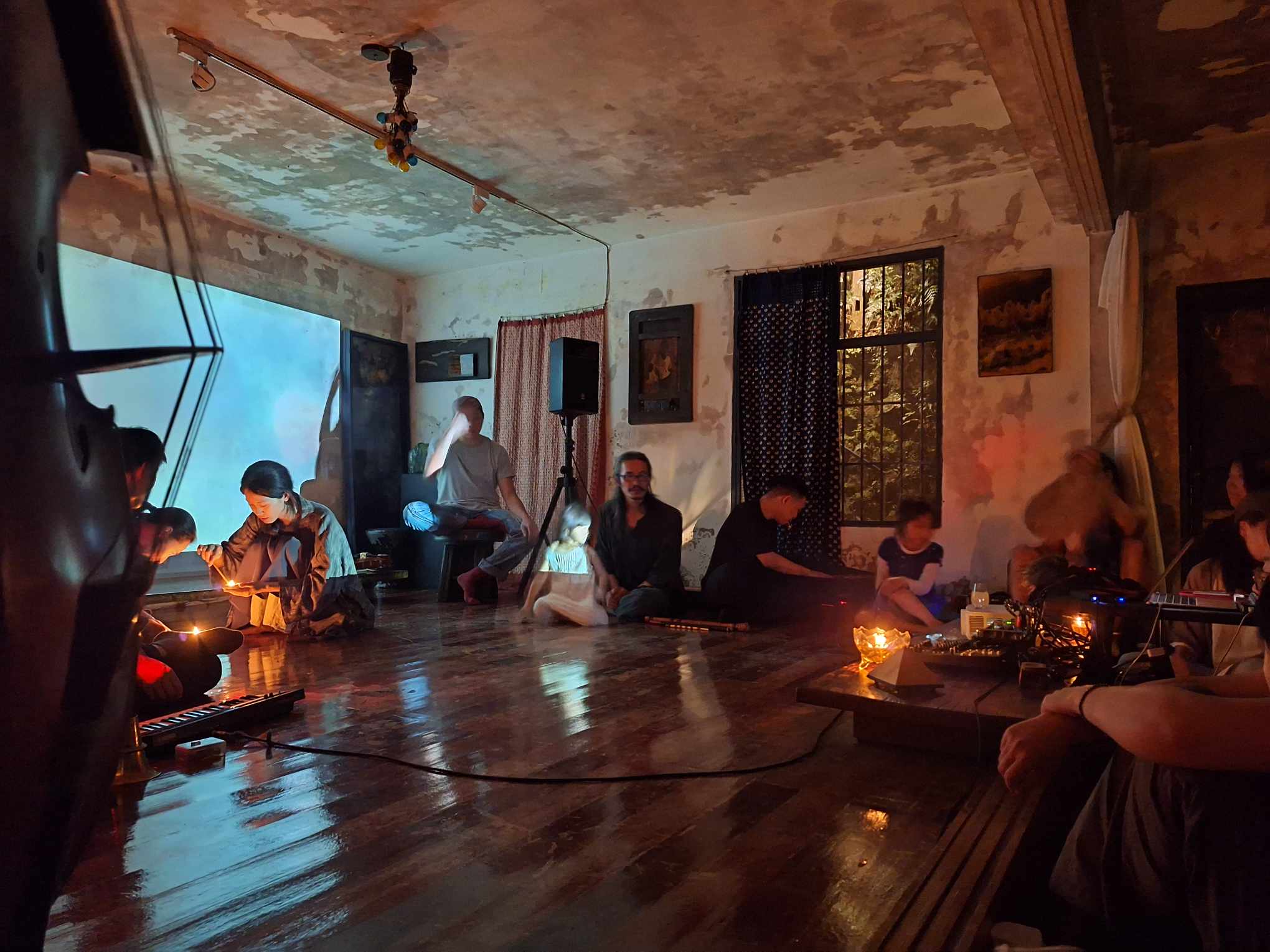
Yesterday, after receiving a tip from an informant, I was able to attend what folks call ‘a mysterious concert’ performed by Vincent Moon and an ensemble of Taiwanese performers. I am still not quite sure which genre this concert fits into. I suppose it is something in between Jam and experimental music. Or should I say spiritual music?

The venue for Vincent’s performance was situated within one of the mountains surrounding and overlooking the Taipei basin. In the evening, I sat in the bus climbing up to the YangMing mountain, thinking about what to expect from this concert. To be honest, I thought of nothing apart from figuring out possible routes of getting home, if the concert goes over time. I had the feeling that this kind of concert always works in its own time, in its own world.

Following the instruction provided by the organiser, I managed to arrive at the door of a gallery, hidden at the end of a small alley with some littering scattering on the side. I could hear the unknown insects buzzing along the way. Oh well, I said to myself: I was really with nature.

The gallery was decorated in a rusty style. Earthy tones was found everywhere. The painting. The wall. The wooden furniture. The ceramic plates. The wooden floor covered with beige cushions. The dim lighting. The calm and comfortable milieu gave me a feeling that I was intruding someone’s home but at the same time knowing that I was not. Anyway, I gave my name to the host, a calm and friendly-looking woman who was trying to locate my name on the list of visitors. She said one of her staff has the same given name as me. OK. That was not very common.

After ordering a glass of Osmanthus sweet wine, I sat on the floor in the room, waiting for the performance. Not sure what to do. I certainly arrived early. I looked around and rested my eyes on the screen playing a video that only contained one scene of a moving object – I guessed it looked like a wheel –  with lighting in the darkness. I started to observe the compositions of the audience as people began to arrive. They all looked very young – younger than me – on the average age of 25. They all dressed in more or less the same style – organic and baggy clothing in earthy tones. Or some other clothing that one would wear in yoga practices. Comfortable but quite tight around your body.

Then Vincent appeared. He spoke to his team for today’s performance in English. I realised that he was French. Obviously. How could I not realise! Well, he looked like someone who lived in Tibet for a while. That was his vibe. He wore a red-brick coloured skirt or skort with his ankles visible in my view. There was a scarf embroidered with ethnic patterns wrapped around his neck. I forgot its colour. Probably something bright. They had a rehearsal for a bit – to prepare for the second part of the Jam performance. All performers had a very calm appearance. And solemn. Like someone who attends a funeral for someone who you don’t know quite well but to show your respect. Or like someone who just came out of months of meditation in the mountains. Simply undisturbed.

Then came the music. It was a combination of a video collage about Vincent’s journey in Taiwan and an improvised selection of music by Vincent as a DJ. I found it difficult to describe this kind of music. It was not electronic. Not classic. But experimental. A mixture of religious and electronic elements with some dialogues spoken in Chinese, passages of songs sung in Chinese, Taiwanese and Japanese. There were lights and rivers from the urban landscape piled up with other footage about a medium, a young girl singing and an Aboriginal man. I let myself go with the flow between music, video and the universe. I could feel his performance working at the level of the ‘heavenly heart’ as described in The Secret of the Golden Flower. The sound of the music dissolves your ego into all the worlds with ghosts, spirits and desires floating about and around. Otherworldly but simultaneously worldy. A coming-together of past and future at the moment of here and now.

The music stopped rather abruptly, leaving the audience in silence. Was it the end of the first performance? Yes, it was. Vincent went out to have some wine. I went to the loo. When I came back, I found Vincent back in the room and decided to ask him about his music.

“what did you want to summon with your music?”

He stared at me as if he did not get my question. And silence. I had no choice but to continue..

“was it a synchronicity? Was it an encounter with the spirits, the worlds, the events? What was it?

“its beyond words. People made their own meaning”

“Okay. Was it a transpersonal encounter?”

He laughed at my choice of wording and repeated it: “transpersonal encounter” with a little sparkle in his eyes. I supposed he thought that’s exactly the kind of fancy term used by people from academia. Then he mumbled something along the line that “ look, I had been through a lot in my life…“ and rushed to leave the room by cutting the sentence short, “I really had to go outside”

“Of course, you have another performance.” Said I. Now I felt really embarrassed about my questions.

He gave an apologetic smile and left. I looked at the name card that he slipped into my hand in the beginning of the conversation, right after I told him I was a UK-based researcher. It was written in French. I had it translated into English through my phone. It was about his ‘counselling’ service for all kinds of troubles. No offence but it gave me a bit of a scamming vibe. Especially when he said he can put a smile back on your face and solve all the problems you have in your life. Okay. I bet it is not cheap.

Then it came with the second part of the musical performance. It was a Jam performance. Again, there was a video that served as a cue for performers to guess when to turn in their performance in accordance with others. It was an improvised performance. Soon, as the music rolled out and filled the room, performers became part of the music; the music became part of them. The sounds went into my heavenly heart and made a little ripple there. They brought the world into my heart and placed my heart into the world. There was a boundary between the two; but it was porous for some kind of energies or spiritual exchange. So I didn’t lose myself in all this. I still had a few vague thoughts which I couldn’t remember what they were but my heart was made quiet as if it was surrounded by something larger than anything imaginable. But it was not trapped. The music indeed dissolved the boundary between the self and the world but I suppose it was up to oneself to decide what to do with the situation. It could go either way. To be haunted or liberated.

Not only towards the end of the performance did I realise that the sounds of the music might have the same yet varying effect on the performers. While some looked pretty much undistributed by staying close with their heavenly hearts, others looked as if they were lost in the liminal space. One of them looked into the eyes of the audience and implored: I want love.

Vincent wanted to go out again. He asked everyone to stay and go to the roof for some wine. I realised that was the moment for me to leave for I came there in the capacity as a researcher. I had made myself clear throughout.

Posted by yushan
Throwntogetherness

Throwntogetherness

As this blog centres around the theme of encounters, it makes sense for me to kick things off with a lighter, more personal perspective –– my recent experience with urban encounters during the national railway strike on September 1st.

Anticipating the railway strike for that day, I bought a bus ticket from Hammersmith to Southampton in advance. Well – I thought I had it all figured out, and I even made it to the bus stop around 14:30, a solid half-hour before the scheduled departure time. Little did I know, this marked the beginning of an intriguing episode in the world of urban encounters.

Posted by yushan