
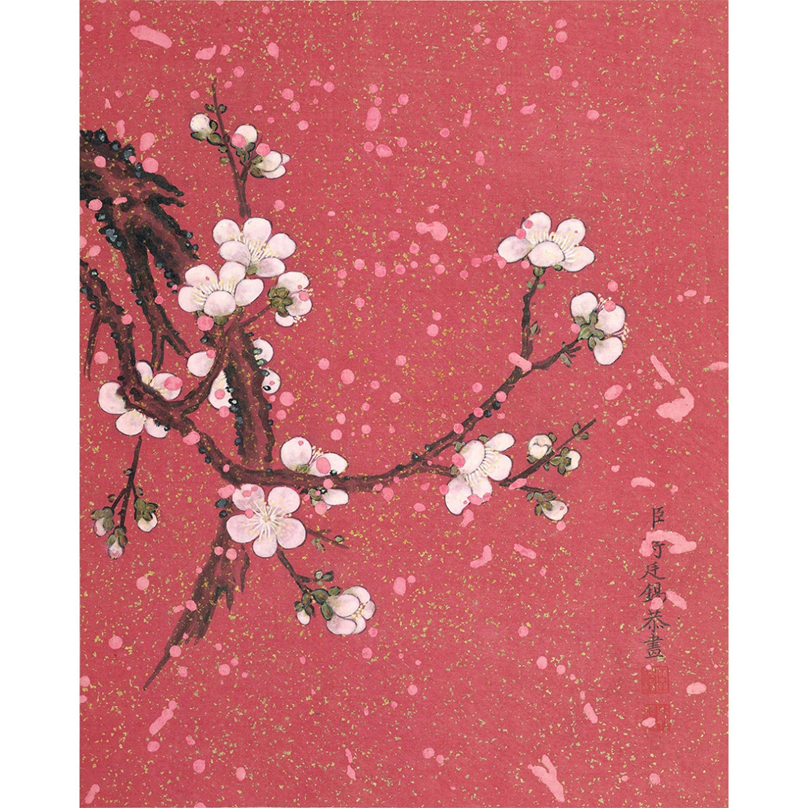
(Paintings and Poetry Devoted to the Countless Fragrant Flowers, Plum Blossoms, Jiang Tingxi, Qing Dynasty. Source: National Palace Museum in Taiwan*/**)
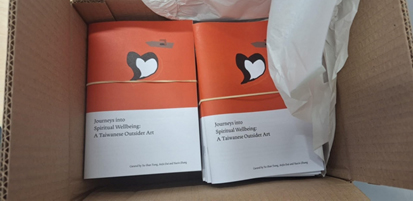
All art books were safely delivered into the hands of anonymous artists and staff members at the Moodii platform company, just as I had promised them. Moodii’s CEO and his secretary have written to me saying that they really appreciate how my research provides them with some unique insights into mental health issues, being able to use art to show the life and spirituality of those mentally vulnerable or ill. I was quite pleased to hear this, although the art book was not really meant to reflect ‘all my life struggles’ as many seems to assume this is the case. And I did the same, as if I could ‘see’ Marco’s ‘trouble’ in his (re)-editing of the book.
It is not always the case that what researchers write about is a complete reflection of who they are, nor do they project their subconscious or unconscious consents, such as repressed desires, sufferings or pains, into their writing. I have been quite careful about not putting my ideas into the heads of interviewees/artists. But does one’s subconscious content find its way into the curation of the artwork and the subsequent book? Yes, it is a possibility. But does this change the reality that researchers intend to find out? To what extent the reality is just a reflection of researcher’s mind, such as fear, anxiety, insecurity and perhaps intellectual idea? Would the ‘truth’ be differently constructed if these (subconscious) projections are removed?
Then I start to reflect on my roles in the art curation and interviewing participants. I think I see curation as a way of pulling out a thread from what might be thought of as different worlds, genres, and psyches – where things are perpetually forked and fragmented. It is to create a meeting place that holds different pieces together for a direction that sheds light on certain truths buried deep under projections, mirrors, and defence mechanisms. Where does a researcher such as myself stand in all this? I am content with what Edith Stein (2002, p.37) wrote: ‘go out of oneself’ because this going-out leads ‘I’ away from its ‘ego’ into the world. The spiritual ‘truth’ uncovered there is otherwise not possible to see in the individual projections, desires and ideas. Art curation, then, makes it possible to bring in something originally larger by threading differences that let each version of the ‘truth’ shine alongside each other, without setting them in competition. This threading, indeed, is my interpretation of ‘research materials’, and that would have been quite different for a different researcher. In threading, I have found my answers from this research project, which might have been different for participants. These answers are really not all about ‘me’ yet do hold a partial representation of my faith, judgement, and spirituality as a researcher and as a human being.
Similar roles are taken for interviewing vulnerable participants. Edith’s going outside of oneself makes me think, again, of Bourdieu’s (1999, p. 612-615) piece on interviewing as a spiritual exercise. For Bourdieu, the spiritual self is put in his words: ‘forgetfulness of self’. However, he has not explained in detail as to how this ‘welcoming position’ in spiritual interviews (citing Marcus Aurelius, which is probably the Western equivalent of Daoist spirituality) actually works to ‘make the respondent’s problems one’s own’ and ‘understand them just as they are in their distinctive necessity’ (1999, p. 614). This sounds almost like empathy yet without distancing oneself from the researched. And without really saying where does the researcher empathise with the interviewee? It reads like from the interviewee’s emotional world; yet this creates more problems as Bourdieu writes in the later paragraph saying that the interviewee can manipulate this empathy and use this chance to ‘stage’ their statements to the public. In a slightly different way, Edith Stein also couldn’t really solve the ‘verification’ problem in her concept of empathy when the interviewee intends to lie about their feelings alongside other contextual information.
Well, I want to forget about these two concepts for a minute because they are both not helpful in solving practical problems during interviews: hiding information (either intentionally or unintentionally). In recalling years of experience of doing interviews in various places and languages, I think I can tell when an interviewee is lying or, to put this in a nice way, hiding critical information from me. The recent and obvious one is this interviewee who has really answered all the interview questions in a way that is way too perfect. No stutter. Not much pausing. Everything he said sounds like reading out from a well-prepared script. And the critical point comes when he deliberately avoids all the sub-questions on spiritual wellbeing and kindred spirits and so on. As usual, I pretended that I did not know he lied to me about his perfectly crafted experiences and still went through most questions yet rather mechanically. I felt like by the end of the interview both of us knew that this was just a script and we had to just go through and really ‘perform our duties’. I still gave him the research compensation for the interview. And then he lied again to me that he wanted to participate in the art workshop yet disappeared. Well, there you go.
Usually when interviewing officials and policymakers, I would present certain information and use that as a source for cross-examination, but I think that was because I already assumed they might hide information from me and their conduct would damage the validity of my research. So interviews with elites are more like an interrogation; yet with the general public or vulnerable participants, interviews become more like a spiritual practice in a Daoist way where there is still a boundary between the researcher and the researched yet both of you know that you are connected in a way that is not expressible (cf. Bourdieu’s ‘expressed intensity’) but possible to be verified in spoken words afterwards. This is the two positions that I occupy when doing a spiritual interview.
I remember my first Finnish master’s student told me, soon after coming back from a suburban community, that “you made everyone feel very special about themselves“. I started at her description and not sure what to say because I had never thought that way. On reflection, perhaps that is when I realised what it is for an interview to be done in a spiritual way. Each interviewee should feel no fear to express their opinions freely and know that their uniqueness will be understood unconditionally, therefore there is no need to ‘perform’ or ‘charm’ researchers by exaggerating, twisting, or inflating whatever it is they want to say. Unconditional understanding does not allow researchers to commit the crime of ‘symbolic violence’ to the researched. In exchange, researchers get something as truthful as from the soul/heart of participants. Whether these are immediately conceptualisable is another question.
In the spiritual space, it is very easy to know who is hiding the information…but of course, as a well-trained and experienced interviewer, I also know how to sit through and smile and provide that ‘felicitous condition’ without too much effort (Bourdieu, 1990, p. 614), despite deep down there, I know someone is hiding information. However, I am unsure if this felicitous condition is really spiritual at all. Nothing like what Edith describes spirituality as ‘feelings with depths’. But, I’d like to think about spirituality, in a Daoist way, as setting one free from one’s ego and letting go of whatever it is that causes pain and suffering to your ego (rather than ‘completely forgetting about yourself’). This way, I can, again, hold upon two positions that allow me to see through the hidden meanings without personally getting involved and without saying a single word. In contrast to Bourdieu’s ‘taking their problems one’s own’, I take their problems ‘as if’ they are mine but I, all the way through, know they are not my problems. But this boundary does not prevent me from resonating with participants from the heart of the Universe.
Reference:
Bourdieu, P. (1999). Understanding. In P. Bourdieu et al. (Eds.), The weight of the world: Social suffering in contemporary society (pp. 607-626). Polity Press.
Stein, E. (2002). Essential Writings. Orbis Books.
*It is a well-known fact that the KMT ‘brought’ gold and treasures to Taiwan during WW2. The National Palace Museum owns the largest and most valuable Chinese artworks, playthings, china, calligraphies (treasures really) from the royal families.
**This visit to Taipei, I finally found time to take J to the museum and spent some of my salary on purchasing two replicas: one printed on rice paper / another framed in a traditional way. Not that I am ever a big fan of Chinese paintings, but they are something to remember Taiwan by.